
1. Sustainable Corporate Governance // 2. Business model and Course of Business // 3. Social affairs // 4. Environment
2.2 Course of Business
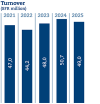
SQS generated around CHF 49 million in 2025, which corresponds to a cyclical decline of around 3%. The slight decline in the EBITDA margin – the ratio of profit before interest, taxes and depreciation (EBITDA) to revenue – to 2.9% is primarily due to two factors:
The planned investments in the development of MS Dynamics 365 as a new system for Enterprise Resource Planning (ERP) and Customer Relationship Management (CRM), coupled with the persistently high administrative burden due to the regulatory environment, are contributing factors. The requirements of government accreditation bodies and private certification authorities are leading to ever-increasing administrative workloads. Furthermore, these bodies, in the name of impartiality and high qualification requirements, are restricting the possibilities for deploying auditors across diverse scopes. This reduces economies of scale, exacerbates the shortage of skilled professionals, and thus drives up costs.
We consider this decline to be a deliberate investment in the long-term viability and quality of our services, rather than pursuing short-term profit maximization at the expense of our assets.
Strategic Business Units 1 and 2
In 2025, SQS had over 100 products in its portfolio. A distinction had to be made between the different types of products:
-
in the accredited area (authorisation to certify recognised standards by state accreditation bodies);
-
in the wider regulated area (authorisation for certification of private standards by private approval bodies);
-
in the non-regulated area.
The full range of services is available on this landing page. Further information on accreditation in general, as well as on SQS's accreditations and approvals, can be found in the blog post «Accreditation: Separating the Wheat from the Chaff». The Swiss Accreditation Service is by far the most important accreditation body for SQS, ahead of the Italian Accredia.
Development towards four core standards
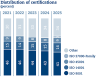
The large – and growing – number of products should not obscure the fact that the majority of turnover is generated by three main standards in the accredited area: ISO 9001:2015 (quality management), ISO 14001:2015 (environmental management) and ISO 45001:2018 (occupational health and safety). Over the last five years, the share of the three core standards in all certifications has always been between 66% and 70% (2025: 66%).
This ratio is likely to shift in the future, provided that the demand for certified information security management systems continues to grow at this rate. In 2025, we will for the first time have more registrations for ISO/IEC 27001:2022 certifications than for ISO 45001:2018. There was also a growing interest in other standards from the 27000 family of information security standards. In the blog post Target practice: How do we make our infrastructure more secure?, we provide practical insights into why companies are increasingly using this service.
The following blog posts from the reporting year, however, show that the three traditional core standards remain the reliable basis for many companies – large and small from a wide range of industries – to manage the complexity of everyday business operations:
The core standards – in particular ISO 9001:2015 – are all the more important as they often provide the basis for customers to integrate additional standards and thus act as a driver for cross-selling, where SQS can exploit the competitive advantage of its broad range of services. A key driver for the expansion of existing mandates is the customers’ realization that integrated management systems reduce operational complexity. We therefore consistently communicated the benefits of integrated management systems in our marketing and communication activities (see for example the blog post IMS – What is an Integrated Management System?). At the end of 2025, 17% of our customers are already using three or more SQS certificates.
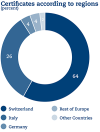
The percentage of certificates issued in Switzerland remained at 64% in 2025, while the percentage of certificates issued in Italy increased slightly again to 26% (25% in the previous year).
ISO4ESG with the Sustainability Performance Standard (SPS)
The diverse applicability and integration capabilities of ISO management systems (ISO-MS) are also the origin of the "ISO4ESG" approach: This acronym stands for the future-oriented use of ISO-MS in the context of environment (Ecology), society (Society), and corporate governance (Governance). SQS has been committed for decades to the pragmatic application and further development of the ISO framework in the Swiss economy. With ISO4ESG, we are highlighting our efforts to utilize ISO-MS for the efficient and effective fulfillment of the increasing demands of sustainable corporate management.
With ISO4ESG, we are pursuing several strategic goals:
-
Satisfy customer needs;
-
Strengthen the long-term relevance of the ISO-MS standards;
-
Use SQS’s ISO competence and ISO reputation in the market for sustainability services for positioning and differentiation;
-
Utilize or create synergies within the SQS.
The Sustainability Performance Standard, launched in 2025, is SQS’s offer to SMEs for the practical application of the ISO4ESG approach. It is characterized by the following features:
-
Focus on the essentials: The SPS demands and promotes concrete measures and visible results – but only in relation to the most essential sustainability issues.
-
Quality and credibility: Certification of the SPS management system confirms that a company is working strategically and consistently on its sustainability. Verification of the sustainability assessment – as an integral part of the SPS – ensures high data quality. This strengthens the foundation of corporate governance and stakeholder trust.
-
Continuous improvement: The SPS is based on the harmonized structure of the ISO management system standards. It therefore utilizes a globally recognized and proven management approach for sustainability and requires users to continuously improve.
In two blog posts, we present the experiences of two pilot customers:
Verification and validation of sustainability information
The verification of greenhouse gas balances according to ISO 14064-1 is the second topic that shaped the development of Strategic Business Unit 2 (SBU2) in 2025. Within the broad field of sustainability information verification, which SQS cannot fully cover, it represents a niche with potential. To leverage this potential, three measures were implemented. Supported by the Sustainability Services department located in Zollikofen, SQS Italy applied to Accredia for accreditation according to ISO/IEC 17029:2019. The goal is to be able to offer accredited verifications of greenhouse gas balances from 2026 onwards. The Swiss Accreditation Body is accompanying this process in order to benefit from the SQS’s experience and to be able to offer the standard itself i.a. at a later date as well. To be able to offer the new verification service as soon as we receive accreditation, we set up an international team of freelance auditors in 2025. Finally, we launched the basic seminar on Greenhouse Gas Accounting according to ISO 14064-1.
The most commercially important service in SGF2 remained the verification of esg2go ratings. The growth of the previous years did not continue in 2025. International political and regulatory developments alleviated – at least in the short and medium term – the pressure on companies to assess and report on their sustainability. However, our message to the market had always been that sustainability should not be seen as a compliance issue, but as a strategic factor in the future viability of an organization. The collection, verification and interpretation of sustainability information is primarily a management tool. This is why esg2go is used as an assessment tool by SPS. For the same reason, in the reporting year the HotellerieSuisse association – with the support of SQS – developed an esg2go industry solution to enable hotels to effectively measure and improve their sustainability performance.
Strategic Business Unit 3
The further education in the field of management system standards and methods had a successful business year. The turnover remained virtually constant at CHF 1.43 million (CHF 1.45 million in the previous year), although the number of events was reduced from 153 to 144. In 2024, we had a large number of webinars to supplement the ISO management system standards with aspects of climate change. In 2025, there was no such extraordinary driver of supply and demand.
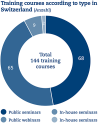
The number and proportion of on-site seminars in the overall program increased, from 58 to 68 and from 38% to 47%, respectively. Participant satisfaction, while still high, declined slightly from 4.6 to 4.5, with a maximum score of 5.0. These figures demonstrate the success of SQS's approach to further education. It can be summarized as follows.:
-
Sustainability is impossible without a holistic approach. Our educational programs are based on the same holistic approach that we apply to assessment and certification.
-
Education is not a canned product. We understand education as a reciprocal teaching-learning process in which the interaction between the participants and with the instructors is crucial.
-
Knowledge must have an impact. We design our educational programs to be targeted and practical.
-
The mix makes it work. Our experienced instructors bring together conceptual thinking and practical experience.
-
No qualification without follow-up. Our training courses are coordinated in such a way that working professionals can continue their education with us over the years, from beginner to specialist, from novice to expert.