
4.2 Greenhouse gas balancing
The period under review covers the period from 1 January to 31 December 2025. The organizational boundaries are drawn according to operational control, which means that the scope of application includes the activities of SQS Switzerland and the subsidiary SQS Italia S.r.l. with its registered office in Milan, as well as information from the upstream and downstream value chains. The activities of the subsidiary SQS Deutschland GmbH with its registered office in Konstanz were transferred to the portfolio of SQS Switzerland in 2024. The registered office in Konstanz was in liquidation in 2025, and no business activities were carried out and no emissions were generated via the registered office in Konstanz in that year. Any expenses and emissions were accounted for via the head office in Zollikofen.
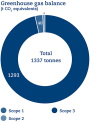
The total emissions for the 2025 reporting period changed only slightly compared to the previous year. Across all emission categories, there was an increase of around 2% (from 1,311 tons of CO2 equivalents in 2024 to 1,337 tCO2e). Direct emissions (Scope 1) are generated by sources that are owned or controlled by us. Indirect emissions (Scopes 2 and 3) are generated by other companies, for example in the production of electrical energy. For the 2025 reporting year, emissions in Zollikofen and Milan (Scopes 1 and 2) amounted to just under 44 tCO2e. This accounted for around 3% of our total CO₂ footprint. Due to our decentralized and global service offering, as in previous years, almost 97% of our CO₂ footprint was accounted for by Scope 3 emissions. Business travel remained the largest driver of emissions, accounting for over 85%. A detailed overview of the emissions, data sources and emission factors can be found in our GHG report.
The data for the greenhouse gas balance sheet are collected once a year and are coordinated by the responsible department. The data for the sustainability report are obtained from a number of internal and external sources. Wherever possible, exact data are used, such as the kilowatt hours (kWh) of electricity consumed, which are included in the electricity bill. No measurements are carried out in-house. For some specific activities, the figures are based on estimates. The uncertainty level of the data sources is described in the greenhouse gas report. SQS aims to achieve high and continuously improving data quality in order to a) provide emission values that are as realistic as possible and b) make the right decisions regarding emission reduction measures. In order to reduce the uncertainty level and create a better basis for decision-making, we adapted the attendance list for seminar participants in 2025, for example. We asked the participants what means of transport they used to attend the training and what distance they traveled for the journey to and from the seminar. The completed lists were anonymized and extrapolated for the entire year.