
1. Sustainable Corporate Governance // 2. Business model and Course of Business // 3. Social affairs // 4. Environment
1.2 About this report
The Corporate Report is prepared annually for the attention of the Members' General Meeting. In it, SQS provides an account of the three dimensions of sustainable corporate management: environmental, social and economic and - as a cross-sectional dimension - corporate governance.
The report is a central instrument of internal and external corporate communication (CC). The primary addressees are the members. Other stakeholder groups that should be informed include employees and the Board (internal CC) as well as the Supervisory Committee, advisory councils, clientele and other market participants, official and political decision-makers and media representatives (external CC).
The report is based on the normative categories and principles of the Communication on Progress to the UN Global Compact (governance, human rights and labour standards, environment) and the Global Reporting Initiative (economy, ecology, social affairs).
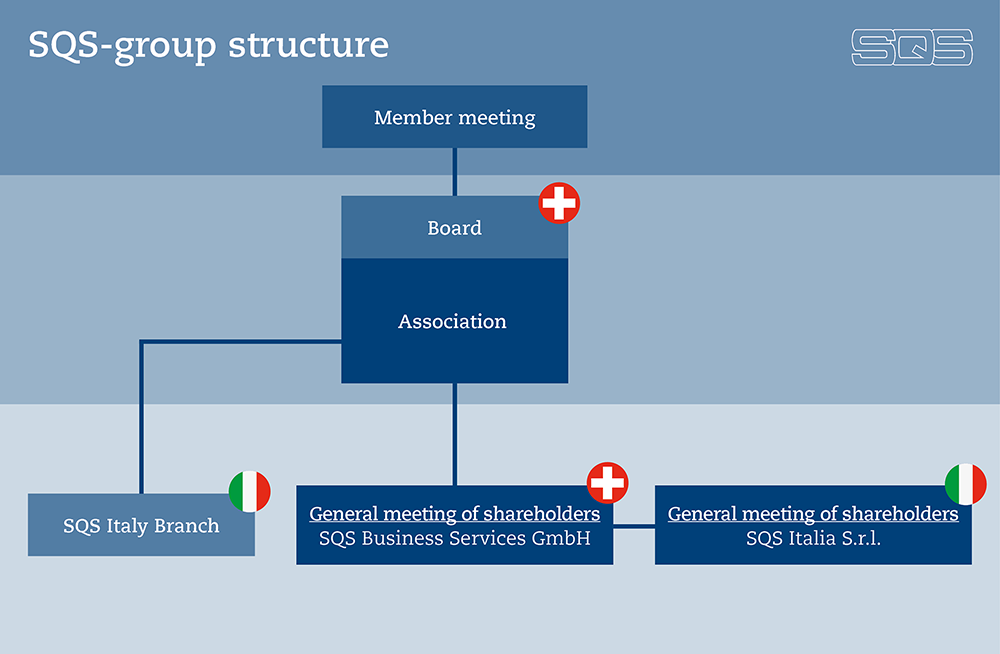
SQS-Gruppenstruktur
Delimitation
The corporate report refers to the activities and impact of the following organisations:
-
The Association SQS based in Zollikofen, Canton of Berne;
-
The SQS Business Services GmbH based in Zollikofen, Canton of Berne;
-
The branch office SQS Italy in Mailan as well as the subsidiary SQS Italia S.r.l. based in Milan, Italy;
-
The subsidiary SQS Germany GmbH based in Constance, Germany (in liquidation).
The subsidiaries in Germany and Italy are currently not subject to auditing and are therefore not included in detail in the financial reporting. Nevertheless, they are subject to the same strict governance and sustainability requirements set by SQS. Otherwise—and unless otherwise noted—the information in this corporate report refers to the organizations mentioned above.
The branch office in Milan is legally part of the association SQS and offers products accredited or authorised in Switzerland in Italy, while the Italian subsidiary offers products accredited or authorised in Italy. Operationally, there is a large overlap between the two units.
Furthermore, the association SQS has holdings in the following organizations:
-
EASY-CERT Group AG (minority interest)
-
CargoSousTerrain (minority interest)
In addition, SQS is represented as a supporting organization - together with the Swiss Association for Quality (SAQ) - on the Board of Trustees of the sfaq Foundation for Research and Education «Quality».
These holdings are mentioned in the report if SQS has exerted relevant influence on their activities and effects or has experienced relevant influence from their activities and effects.
Unless otherwise stated, all information relates to the calendar year 2025 resp. the reporting date of 31 December 2025.
Materiality
We derive the materiality of our activities and impacts from our association’s statutes and our understanding of the role of SQS in sustainable development (see Chapter 1.1). We exercise responsible corporate governance across the three dimensions of sustainability in collaboration with and in relation to the following stakeholders:
-
Clients
-
Full-time employees and freelancers
-
Members and organs of the association
-
Regulators (norms and standards setters, accreditation and authorisation bodies, legislators, authorities)
-
Partner organizations (including organizations of which SQS is a member)
-
Consultants of SQS clients and other market participants
We are aware that the significance of our activities and their impact is not determined by the size of our organization, but by the nature of our services. The quality and consistency with which we fulfill our association's mission have an impact on the trust between market participants and therefore on the functioning and legitimacy of the market. Due to our mission and our client structure, these activities and effects relate primarily, but not exclusively, to Switzerland.
|
Economic Responsibility (Chapters 1 and 2) |
Social Responsibility (Chapters 1 and 3) |
Ecological responsibility (Chapters 2 and 4) |
|
Financial independence and competitiveness: SQS is an association that finances itself through the sale of services. It must be competitive in order to survive and develop in the market. |
Employment and working conditions: The business of assessments and certifications is and will remain a "people's business". Attractive employment and working conditions are crucial to remaining competitive in the race for skilled workers. |
Environmental and climate management: Systematic environmental management, and especially the credible accounting and reduction of greenhouse gas emissions, are strategic issues for SQS's own services and organizational development. |
|
Ethics and Compliance: SQS is an accredited KBS whose certificates are globally recognized and open up market access. It must therefore meet high regulatory requirements and cultivate an ethical organizational culture. |
Training and further education, as well as employee development: There is no training for auditors on the market. This is why SQS invests a lot in the training and further education of its employees. This also applies to employees in the back office, who are increasingly required to have specialist knowledge. |
|
|
High-quality services and innovation: SQS aims to support its clientele on their path to continuous improvement. This requires competent and practical auditing and innovative services. |
Health at the workplace: SQS wants to be a responsible employer that provides its employees with a healthy working environment in every respect. |
|
|
Comprehensive services: The SQS is an association that serves the Swiss economy and SMEs in neighboring countries. For this reason, it offers a wide range of products that are not geared to profit maximization, but rather to the needs of SMEs in particular. |
Digital responsibility: Digitalization presents the SQS with both great opportunities and risks. Information security is a prerequisite for our credibility and is the subject of a new core product, namely certification in accordance with the ISO/IEC 27001:2022 standard. |
|